
And what Is chance other than the rough stone,
That takes life under the sculptor's hand?
Chance is given by Providence
For purpose Man must shape it
(Don Carlos)
Our poet was born on November 10, 1759 in Marbach, very weak, and was baptized on November 11.
His father Johann Caspar is a soldier, adventurer, surgeon in Duke Carl Eugen's army and makes it to captain and later director of the ducal court gardens at Solitude.
He adopted his father's diligence, ambition, sense of duty and, above all, internalized his father's sense of order. The tragic catastrophe in The Robbers emerges from the disruption of this paternal order.
The mother, an innkeeper's daughter from the prestigious Gasthof zum Goldenen Löwen in Marbach, suffers silently under her patriarchal husband and reads pietistic writings (Bengel). As her father has speculated in the timber trade, the family becomes impoverished and moves to the countryside in Lorch. This becomes an idyll for Schiller. He takes Latin lessons from Pastor Moser, later immortalized in The Robbers.
Moves to Ludwigsburg at the age of 8. (second Versailles) Enrols in the Latin school. 1767-1773: graduation qualifies the young Schiller to study theology. Since Duke Carl Eugen's officers have free admission to the court theater, Schiller becomes familiar with the world of theater and art at a very young age.
1773 Duke Carl Eugen thwarts the young Schiller's plans to study theology. The son of his captain is ordered to attend the military Karlsschule at Solitude near Stuttgart. His father tried twice to persuade the duke to allow his son to study theology, in vain, Fritz would be grateful to his father all his life for his efforts on the Duke's behalf.
And this is where my chat about the young Schiller begins.
He did not like to wash himself -
Our poet, who is described in biographies as THE advocate of purity, beauty, aesthetics, ideals and high virtues and as such we will certainly encounter him again in this seminar. And rightly so, only he was a HUMAN
with weaknesses and faults. It is common today to look for bad habits and character flaws in the youth of the person concerned - often this is exaggerated as an excuse, sometimes it is really true.
When Schiller writes: “Through a sad, gloomy youth I entered life, austere, unloving - a hell”, then you can recognize many a later reaction in life. Our own and others' statements, quotes and letters make this clear. Characteristics and actions that alienate us, that for us do not seem to fit in with the genius of the century, who was filled with a sense of mission to change the world and people for the better.
There was everyday life, the very real demands of life - as I said, he was only human. And a man.
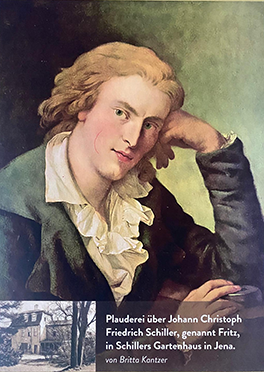
What does this young Schiller look like? He is pale, freckled, red-haired, slight, grows quickly - which could be another reason for his later illnesses - and will grow to be 1.80 m tall. Goethe is only 1.69 m tall.
At the hated military school (Militärpflanzschule), barracks, compulsory uniform and strict isolation from the outside world prevail.
At the age of 15, Schiller was still wetting the bed and was severely punished twice for this and for secretly reading Klopstock, Lessing and Goethe or sniffing tobacco.
He wrote to his duke (personal tutor) “You will find me stubborn, hot-tempered, impatient. I also did not pay as much attention to the cleanliness of my body as I should have done.
He has to powder his hair because the duke hates red hair. He has to wash all the time, keep his clothes clean - he doesn't want to. Let him call me “pigskin”. He doesn't care.
1774 A law faculty is added to the Karlsschule, Schiller studies law for 2 years, then drops out, still inclined towards theology.
1775 The military school is moved to Stuttgart and a medical faculty is added. Schiller changes and compares the study of medicine with poetry.
Inspired by a brilliant professor of philosophy and psychology, Prof. Abel, Schiller studies Rousseau and Shakespeare's plays intensively and publishes his first poem in the Schwäbisches Magazin.
1777 Begins work on The Robbers.
1778 Postpones his poetic activities in order to study bread science.
1779 1st dissertation: Philosophy of Physiology is rejected.
1780 2nd dissertation is rejected. In a few days he submits his 3rd dissertation, which is a revised version of his 1st dissertation: “On the connection between the animal nature of man and the spiritual”. It is accepted and printed.
He was then discharged from the Karlsschule and sent to Stuttgart as a military doctor.
He doesn't take his job as the regiment's hated medic very seriously: he prescribes high doses of emetics for all kinds of ailments without a second thought: “They should vomit out their illnesses.”
He lives in a hole that stinks of tobacco - Goethe is said to have once said that Schiller could only write poetry while smelling rotten apples. He sleeps until midday, hangs out in pubs with “beautiful guys” and is considered a drunkard because he often has to be carried home drunk. There is also a pattern here: he has drunk more in his life than was good and thus ruined his health.
After the 8 years of hard Karlsschule, living only with “beautiful guys”, there was a great need to catch up on everything that had to do with pleasure and enjoyment. He overdid it and probably had inhibitions about anything to do with women.
So first to the brothel, “en compagnie”. “Honor women, they braid and weave heavenly roses into earthly life”, that was the theory. The practice was initially called Luise Dorothea Vischer, whom he addressed as Laura: “Laura, Laura mine”. However, this did not prevent him from “enjoying the animal pleasure of jumping around” with her or the “soldier's wives”.
This “rather desolate bohemian life with gambling, scratchy crying, bad snuff and nasty women” - he describes himself as a “voluptuary”. A contemporary report said that during a single intercourse he snorted 25 pinches of tobacco while roaring and stamping.. At the same time, he wrote an essay on “Grace and Dignity”.
1781 The Robbers is self-published anonymously,
He has to take out a loan. This was the beginning of a debt that would accompany him for the rest of his life.
1782 Schiller's stage adaptation of The Robbers is performed in Mannheim. A great success. Schiller is present incognito. He is subsequently arrested in Stuttgart for leaving the country without permission.
Schiller then flees to Mannheim with his friend Andreas Streicher.
He is 22 years old, now famous throughout Germany, a public soul.
When in fear of the duke's henchmen, but also of his creditors and betrayed women, he flees to Bauerbach to the mother of his friend, Wilhelm von Wolzogen. Here he finds asylum.
Henriette von Wolzogen becomes his patron - until he falls in love with her 16-year-old daughter Charlotte and asks her to marry him in a wild letter. Henriette had other plans. What could this penniless commoner with no money and no future offer an aristocrat?
1783 He goes back to Mannheim, gets a job as a playwright for a year, is poor, falls ill with malaria (which was rampant in the Rhine region at the time) and treats himself. “Water soup today, water soup tomorrow and fever bark I eat like bread”. But for the bottle of Burgundy he needs to write, he begs for money.. He joins the “German Society” and gets to know Wieland and Klopstock in person.
1784 His play Kabale und Liebe (Cabal and Love )is a great success. (Title change recommended by Iffland, famous actor, director and playwright in Mannheim, previously Luise Millerin)
He has had no luck in love so far. Then he meets 22-year-old Charlotte von Kalb, a year younger than himself, who has been married against her will to Court Councillor von Kalb, who loves not her, but her fortune, which he spends.
She is beautiful, voluptuous, exalted and hopelessly romantic. They become inseparable. He reads to her. She teaches him manners and he often stays late into the night while her husband is traveling.
The Mannheim theater director Heribert von Dalberg is dissatisfied. He cuts all the crucial passages about tyranny and murder from Schiller's “Fiesco”. What's the point? The people “should have a nice evening”. So much effervescent language, so much blazing idealism - and why does man walk around so untidily, his hair badly coiffed and then he borrows money everywhere and can't finally get rid of his fagging. The contract is not renewed.
Schiller is left without money, but with debts. Charlotte becomes a shackle.
1785 Schiller flees once again. In Leipzig, he meets friends for life. Gottfried Körner and Ferdinand Huber and their families repeatedly prove to be saviors in times of need. As was the fashion, Schiller loved his friends enthusiastically. “Be embraced millions, this kiss of the whole world! Brothers...” He exchanged daily letters with Körner, but he also used and exploited his friends.
Schiller dedicated the ode “An die Freude” (To Joy), one of his most famous poems, to the Masonic lodge “Zu den Drei Schwertern” (To the Three Swords ) in Dresden. It was set to music by Ludwig van Beethoven ( among others) in the 4th movement of his 9th Symphony.
Speaking of Freemasonry, Rosicrucianism, secret orders, Spirititism, these flourished in all European countries in the 18th century. (Think of Mozart's Magic Flute, Haydn, Frederick the Great, Lessing, Herder, Wieland, Goethe and many other intellectual greats, etc. The aim was: self-perfection of man, to improve oneself, the inner temple, and society, the outer temple.
Schiller and Kant were certainly infected by it. Thus, he begged his friends again and again with tearful eloquence to use all their powers, each in his own field, to become outstanding people whom the world would one day hate to lose.
The friends in Gohlis near Leipzig called themselves “The Blessed Five”. (Huber, Körner, Schiller and the Stock sisters) They spoil the poet - enabling him to lead a carefree life - and watch with concern as he falls in love at a ball with a very beautiful woman of dubious reputation, Henriette von Arnim. When things threaten to get serious, Körner, horrified, enlightens the enamored man. His mother is a procuress and Schiller is not the only suitor.
But he runs there night after night with presents until the mother asks the poor poet not to ring the doorbell when a light is on in the window - then her daughter is busy.
The liaison is over, but so is his stay in Leipzig.
1786 Schiller moves to Weimar. There now lives
Charlotte von Kalb, his former lover. She provides him with an apartment. He meets her again and then writes unconcernedly: “My relationship with Charlotte begins to become quite loud here and is treated with a great deal of respect for both of us”. She also gives him access to good society - the revolutionary attaches great importance to this, and not just for understandable material reasons. All the friendships he now makes in Weimar help him to realize his dream of “greatness, prominence, influence on the world and immortality”.
Along the way, he falls in love with Margarethe Schwan, the daughter of his publisher, and asks her father, rather than her, for her hand in marriage; nothing comes of it - then he sets his eyes on one of Herder's daughters, a relative of Wieland's, and at the same time writes a letter to Court Councillor Kalb, probably about the divorce Charlotte wants. Although she fears social ostracism and being compromised, she loves Schiller far more than he loves her. Mr. von Kalb is not known to reply. Schiller portrayed him as a figure of ridicule in “Kabale und Liebe”, out of pure malice, as he admits.
1787: Schiller is 27 years old and destitute. Visits the Lengefeld family in Rudolfstadt. He meets the two sisters Caroline and Charlotte.
After this visit, he commented: “Both creatures are - without being beautiful - attractive and I like them very much.” He now began to think seriously about stability in his life, which he envisioned according to the old pattern of “the woman has to serve” or “and inside reigns the chaste housewife”.
After Charlotte von Wolzogen and Charlotte von Kalb, this was now the third Charlotte to play a role in his life.
Charlotte to play a role in his life - but what kind?
There can be no question of love at first sight.
If any of the sisters appealed to him, it was Caroline, who was three years older, already married, more impulsive, livelier and wittier. This type of woman had an easy time with him.
He writes: “It is strange, I adore and love the warm, sensitive nature - and a coquette! Every coquette can captivate me. Each has an infallible power over me; none can inflame me, but they can disturb me. I have high notions of domestic joy, but not so much as to desire it. I will nibble at all happiness without taking it too seriously. All womanhood is open to me; and yet, I wish to be determined.” He saw his problem clearly: one or the other?
Charlotte was pretty, gentle and innocent, Caroline entertaining, fun-loving and experienced.
He wanted both of them and so he developed what he had in mind, a life for three. He wrote of his “sweet conviction that you are mine, that nothing can snatch you from me. We have found each other as we were made for each other. No desire lives in me that my Caroline and my Charlotte could not satisfy inexhaustibly...”
His letters to both of them speak for themselves. He dreams of a “ménage à trois”. “Oh, how wonderful it would be if in future everything between us could be communal. Schiller gave no thought to what this “happy union” would look like in everyday life. He dreamed the male dream of a marriage with the division of responsibilities in orderly domesticity and an exchange on intellectual heights.
It is here in the Lengefeld family garden that Schiller meets Goethe. However, the latter hardly took any notice of him.
Those around him were divided in their opinions about what was going on with the Lengefeld sisters in Rudolfstadt. A letter from the painter Grass, who often visited Schiller, wrote in 1791, when Schiller was already married to Charlotte: “It seems like a fairy tale to me that two ladies share the love of one man - without strife and jealousy.
There was no moral disapproval in this letter.
On the other hand, Wilhem Frielitz wrote sharply: “That such a marriage of three is considered possible, even beautiful - I see no reason not to disapprove of the impossible and illicit.”
And there were even nastier comments claiming that Schiller had only married Charlotte in order to continue having an affair with Caroline (she was married). Alexander von Humboldt and Rahel Varnhagen also made similar comments.
How did young people at the time come to embark on such dangerous love affairs? On the one hand, it was literature: Stella by Goethe, Werther, Rousseau's epistolary novel The New Heloise and many other works that have since been forgotten.
And then the French Revolution's ideas of freedom and equality were in people's heads.
What a duke is entitled to do with his mistresses is also possible for me - and society at the time tolerated it and behaved no differently. In short, Schiller did what others before and after him liked to do.
When Schiller chooses Charlotte, she is unhappy. She doesn't feel up to the poet. And everyone can see that he kisses Caroline more passionately than she does! But then he writes to her: “What Caroline has ahead of you, you must receive from me, you must be my creature”
So they get married. As there is no room in the apartment, Schiller's wish to take his sister-in-law into the new household in Rudolfstadt is dashed. But the “beauty with the full bosom” moves into lodgings nearby and stays.
“When I saw Caroline leaning over him, the expression of supreme love in every move, ah, I cannot describe it to you,” wrote Wilhelm von Humboldt to his fiancée. He was a close friend of Schiller and later moved to Jena to be near him.
But ... the gentle Lotte slowly wins the game. She doesn't demand, she doesn't nag, she listens – creates the peace and order that Schiller needed for his work. She also endured the intermittent pulses of his passion. She became vital to him.
She brought up their four children, kept his back free and did not allow his arrogance, often shown to her in public, to deter her from serving him. The ideal poet's wife. This is not a role for Caroline. She throws herself into a new liaison - but always returns to Schiller.
The victim of the story is Charlotte von Kalb. Initially, Schiller fostered a friendship with the sisters without declaring anything about his intimate relationship. Charlotte now wanted a final divorce. Schiller feared that she might destroy his happiness with revelations. It was not in keeping with his moral standards that he played the role of the schemer. His unfair behavior towards the woman to whom he owed so much is difficult to understand. He denounced her and tried, rather shabbily, to ruin her reputation, so that the sisters rejected her and wanted nothing to do with her. Charlotte received no more replies to her letters, remains silent and withdraws her divorce.
Unlike Goethe's love affairs, this exciting, psychological story of a double - or shared - love for the sisters has remained largely unknown. They were an embarrassment to biographers, especially Caroline, who erased all traces of it in her book Schiller's Life.
Schiller was awarded a doctorate from the University of Jena in 1788. He moved to Jena.
In 1789, he received a professorship for history (unsalaried) at the suggestion of the Weimar court - Goethe.
The inaugural lecture “What does universal history mean and to what end does one study it?” degenerates into a social event in which the whole of Jena wants to participate. The following lectures are sparsely attended. Schiller is not a good speaker.
He becomes engaged to Charlotte, and in 1790 they marry.
In this year, Schiller also receives the title of Meiningen Court Councillor.
In 1791, Schiller falls seriously ill from which he never recovers, despite stays at spas in Karlsbad and Erfurt. (due to tuberculosis, which was never cured). What then follows is known as Schiller's wager: “Let us see who will cheat whom, the mind the body or the body the mind”. (Wallenstein, “It is the mind that builds the body).
He is granted leave of absence from his lectures.
At this point I would like to mention how strongly
Schiller changed during his marriage and in his 30s, perhaps also as a result of the serious outbreak of illness. Goethe said of him: “Schiller is a completely different and ever better person every 8 days!”
But he also said that when he met him, he believed Schiller would only live for a short time.
My chat about the private Schiller should end on a friendly note.
All reports tell us that Schiller was at his cheeriest when he had his “little bunch together”. He clung to his children with the most tender fatherly love. The children loved him indescribably.
The certainty of being loved in this way helped him through his serious bouts of illness. “From this side of my family's love, heaven has given me nothing but joy.”
He endured his serious illnesses admirably throughout his life. - It all began with malaria and tuberculosis in Mannheim.
Johan Voss tells a funny story about this:
“One day he was once again severely afflicted, his inflamed intestines were not working properly. I advised him to just give it a try and wait patiently. ‘You're right,’ he said, ‘opportunity makes thieves’ and followed my advice.
As he now sat on that chair, which often becomes more important for kings than the throne, he compared himself to Cato, who had also once given audiences in this position. I told him all sorts of amusing stories, which amused him greatly, and so a few happy hours passed! Relief came at last”.
You can't believe everything your competitors have told you. One thing is certain:
Schiller saw it as his duty to complete his life's work, to which he subordinated everything. The bravery and incredible effort with which he endured illness and sorrow, the deprivation and pain with which he forced himself to work, can only touch us deeply. The quality and quantity of what he left us is impressive, especially when you consider the circumstances of its creation.
Schiller's last words on his deathbed are touching: “Immer besser, immer heitrer” (Always better, always more cheerful), no lament - comfort for the desperately hoping and mourning.
His greatest wish has come true: He has become immortal!
Biographical data
1791 Serious illness from which Schiller never recovers. Cures in Karlsbad and Erfurt follow.
Rumors circulate of Schiller's death.
A lucky coincidence brings him a three-year pension from the Danish Hereditary Prince Christian von Augustenburg and Count Ernst von Schimmemann.
Now he can devote himself to studying Kant, which had long been recommended to him by the first well-known Kantian, the Austrian philosopher Carl L. Reinhold.
1792 Repeated. He receives French citizenship. (he is now 33 years old). Fichte becomes Reinhold's successor. Publication of the literary journal Die Horen (1795-1797).
1793 The attacks of illness, fainting, increase.
Schiller presents his friend Körner with the preparatory work for the Kallias letters: “Beauty is nothing other than freedom in appearance.”
1794 At a meeting of the “Naturforschende Gesellschaft” in Jena, there is a lengthy discussion with Goethe about the primordial plant. A ten-year close friendship and collaboration begins, daily correspondence. Writes his first letters: “On the aesthetic education of man.”
1797 Goethe in Jena. The ballad year! Schiller buys a garden house.
1798 Wallenstein trilogy
1799 Move to Weimar. “Nänie” is created.
1800 Stage adaptation of Macbeth, Maria Stuart, great success.
1801 Further success with The Maid of Orleans etc.
1802 Sale of the house in Jena and purchase of a house in Weimar. (42 years old) Elevated to the nobility.
1803 Bride of Messina, convalescent stays. Completion of William Tell (material had been given to him by Goethe)
1804 Weimar performance of William Tell is a great success. Further serious bouts of illness. Plan to move to Berlin is made: Visit to Berlin. A financial incentive comes from Weimar (Goethe). Schiller returns.
1805 Work on unfinished Demetrius (impostor theme)
Further very severe bouts of illness. Schiller's faithful friend Johann Heinrich Voss, who has moved close to him, watches at his bedside. 1 May: last visit to the theater. Schiller meets Goethe on the way. Last preoccupation with “Demetrius”.
May 9th Schiller's death
He died of acute pneumonia, probably caused by his tuberculosis.
Goethe wrote that he thought he had lost half his life, even himself, at Schiller's death. He secretly stole Schiller's skull and wrote: “Contemplation of Schiller's skull”.
Schiller's grave today in the Fürstengruft in Weimar next to Goethe. (since 1827). It is empty, the search for Schiller's real skeleton has been abandoned.
 Print
Print 